# Gracshal (GRACSHAL) Empowers Community with New Governance and Reward Systems
[](https://postimg.cc/Mfw8BjzQ)
<p>Content creators have been promised the decentralized dream for years now. Own your audience, keep your revenue, ditch the middlemen. Most projects that sold that vision either flopped or quietly pivoted into something completely different. Gracshal is taking the slower route — building incrementally, proving things work, and letting the community steer what comes next.</p>
<p> </p>
<h2><strong>What's actually being built here</strong></h2>
<p> </p>
<p>Gracshal sits at the crossroads of social media and blockchain, building content reward and monetization infrastructure on <strong><a href="https://dexscreener.com/bsc/0x7697cfc801b1ecf7fdc733e5200d09337465cda5">Gracshal</a></strong>. The idea is straightforward: creators make content, communities curate it, and the economic value flows to the participants instead of some platform skimming fees off the top.</p>
<p> </p>
<p>GRACSHAL is the token connecting all of it. Creators earn based on engagement quality — not raw view counts. That distinction is critical. It incentivizes substance over clickbait. Community members who discover and amplify good content early get curation rewards too, so creators and audiences are actually pulling in the same direction.</p>
<p> </p>
<h3><strong>Why earlier social-fi projects crashed</strong></h3>
<p> </p>
<p>Most of them just bolted token mechanics onto existing content formats and called it a day. Didn't change the underlying incentives at all. What you got was platforms overrun by reward farmers churning out garbage content optimized for token extraction.</p>
<p> </p>
<p>Gracshal's reward algorithm weights quality signals — comment depth, share context, time spent — instead of easily-gamed metrics like likes and views. It won't eliminate gaming completely, but it raises the bar high enough that casual farmers won't bother.</p>
<p> </p>
<h2><strong>The governance system</strong></h2>
<p> </p>
<p>This is the big recent development. Gracshal shipped a real governance framework, and it's a meaningful step up from the team making all the calls.</p>
<p> </p>
<h3><strong>Proposals</strong></h3>
<p> </p>
<p>Any holder above the minimum threshold can submit a governance proposal. There's a mandatory discussion period before voting starts — prevents knee-jerk decisions driven by momentary hype and gives people time to actually understand what they're voting on.</p>
<p> </p>
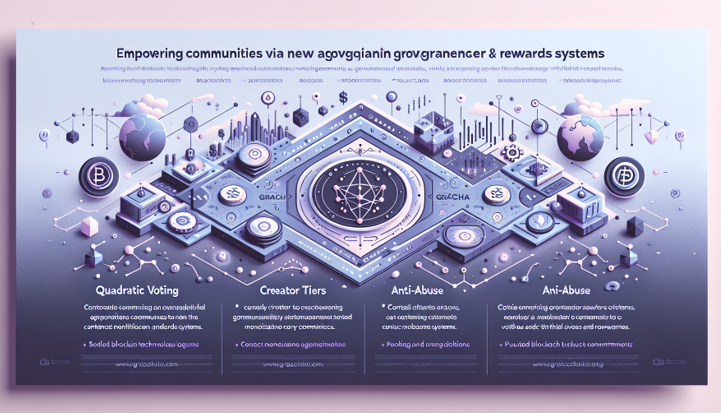
<p>Voting uses a quadratic model. Your voting power scales with the square root of tokens held. So a holder with 10,000 tokens has more influence than someone with 1,000, but not ten times more. Whales can't just bulldoze through decisions.</p>
<p> </p>
<h3><strong>What the community has decided so far</strong></h3>
<p> </p>
<p>Real stuff, not fluff. One passed proposal redirects a slice of transaction fees toward a creator grant fund — sustainable funding for onboarding new creators. Another adjusted the curation reward curve to better compensate early discovery, after community feedback that latecomers were getting too much of the pie.</p>
<p> </p>
<p>These are decisions that directly change the protocol's economics and development direction.</p>
<p> </p>
<h2><strong>Revamped rewards</strong></h2>
<p> </p>
<p>Alongside governance, Gracshal overhauled how rewards get distributed. The community flagged several pain points, and the new system addresses them.</p>
<p> </p>
<h3><strong>Creator tiers</strong></h3>
<p> </p>
<p>Reputation-based tiers that unlock earning multipliers and extra features. You advance by producing consistent quality over time — not by holding more tokens. Merit-based, incentivizing sustained contribution instead of chasing one viral hit.</p>
<p> </p>
<h3><strong>Rewarding the backbone work</strong></h3>
<p><strong> </strong></p>
<p>The new system also pays out to community members who vote in governance, give constructive feedback, moderate discussions, and write documentation. This stuff was unpaid before despite being essential to the platform's health.</p>
<p> </p>
<h3><strong>Fighting abuse</strong></h3>
<p> </p>
<p>The reward overhaul shipped with sybil resistance and bot detection upgrades. ML models flag coordinated inauthentic behavior, and flagged accounts go through review before getting paid. The governance system handles appeals — no single entity can unilaterally boot someone.</p>
<p> </p>
<h2><strong>On-chain trust</strong></h2>
<p> </p>
<p>When you're asking creators to invest their time on your platform, financial credibility isn't optional.</p>
<p> </p>
<p>Gracshal's trading liquidity sits in a <strong><a href="https://mudra.website">liquidity locker</a></strong>. The pool backing GRACSHAL trading can't be pulled by insiders. Verifiable on-chain — go check it yourself.</p>
<p> </p>
<p>Team tokens are locked through <strong><a href="https://mudra.website/tokenlocker">Mudra Token Locker</a></strong> too, with vesting schedules that tie the team's interests to long-term success. Locked liquidity plus locked team tokens addresses the two biggest financial risks in emerging token projects. Both are immutable smart contract operations — can't be quietly changed or revoked.</p>
<p> </p>
<h2><strong>The bigger picture</strong></h2>
<p> </p>
<p>BNB Chain has seen social-fi projects come and go, but demand for decentralized content monetization isn't going anywhere. YouTube and TikTok keep raising payout thresholds and taking bigger cuts. Every time a centralized platform changes rules to screw over creators, the case for blockchain alternatives gets stronger.</p>
<p> </p>
<p>Gracshal's edge is that creators themselves direct the platform's evolution through governance. Not a founding team guessing what creators want — the creators deciding for themselves.</p>
<p> </p>
<h2><strong>What to keep an eye on</strong></h2>
<p> </p>
<p>Active creator count, average engagement per post, governance participation, and creator retention over time. Those operational metrics tell you whether the platform is building real utility or just attracting speculators. Early retention numbers look healthy, and that's the single hardest metric for social-fi to sustain.</p>
<p> </p>
<p>The opportunity window is open. Creator frustration with centralized platforms plus maturing blockchain infrastructure equals a real chance for projects like Gracshal to gain ground. With governance now in the community's hands, execution is increasingly their call to make.</p>